
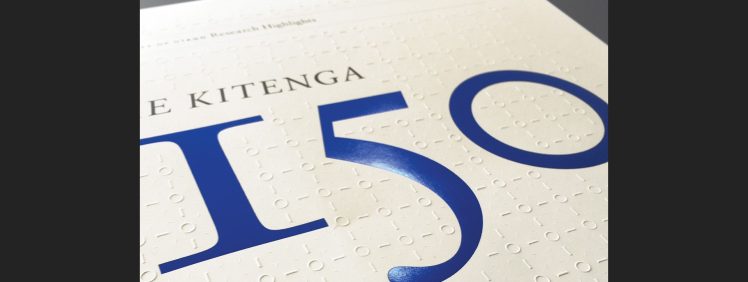
Embossing and debossing print embellishments create a raised area on paper or board. These are the same process—the only difference is the result: Either raised (emboss) or recessed (deboss). GSM takes a look…
Firstly, embossing/debossing is always done after printing is complete, as a separate process. The process uses a stamp-press or Letterpress loaded with two metal die-blocks—a male (raised) and a female (recessed) block. The blocks are loaded opposing each other on the stamp-press. As sheets of paper or card feed through the press—one block hits against the other, sandwiching the stock and creating a three-dimensional impression. Typically, the height or depth of the stamped impression is between 0.15—0.5 of a millimetre (15—50uM). Embossing versus debossing is determined simply by which block hits from which side of the stock.
Blind Emboss
When this process is done without registering the impression to a printed element on the substrate—it is called ‘Blind’ Emboss/Deboss. The desired effect is a raised or recessed area that does not directly correspond with printed content.
Registered Emboss
When this process specifically lines up the impression with a printed element, this is called ‘Registered’ Emboss/Deboss. An example is a printed word or graphic embossed/debossed from the surrounding content.
Combination Foiling
Finally, embossing/debossing can be combined with Hot Stamp Foiling, done simultaneously as a single process using the same blocks—this is called ‘Combination’ Foiling and is explained overpage.
Design Tips
An important design consideration for embossing/debossing is that it always results in a counter-impression on the reverse side of the sheet, which can look odd if text or an image runs across it. Therefore, you need to consider this during the design process
Embossing/Debossing & Paper Stocks
An important consideration when it comes to embossing/ debossing is paper stock. Whilst most stocks can be embossed/debossed—some are more effective than others. Thicker stocks will tend to yield a more pronounced effect and will also be less likely to tear or burst under the stamping pressure. Stocks containing cotton are particularly suited to this process as these fibres help make the paper more malleable.
 Blind Embossing and Hot Stamp Foiling
The cover on this folder uses both Blind Embossing and Hot Stamp Foiling. Achieving this look required two separate embossing passes using different block sets.
The non-printed raised pattern across the surface is a blind emboss created using a male plus female block (the female block is shown on the left).
The blue numerals, which are a non-metallic pigment foil, have been created using Hot Stamp Foiling. This process uses a different male block (shown in the image on the right) from the one used in the other process.
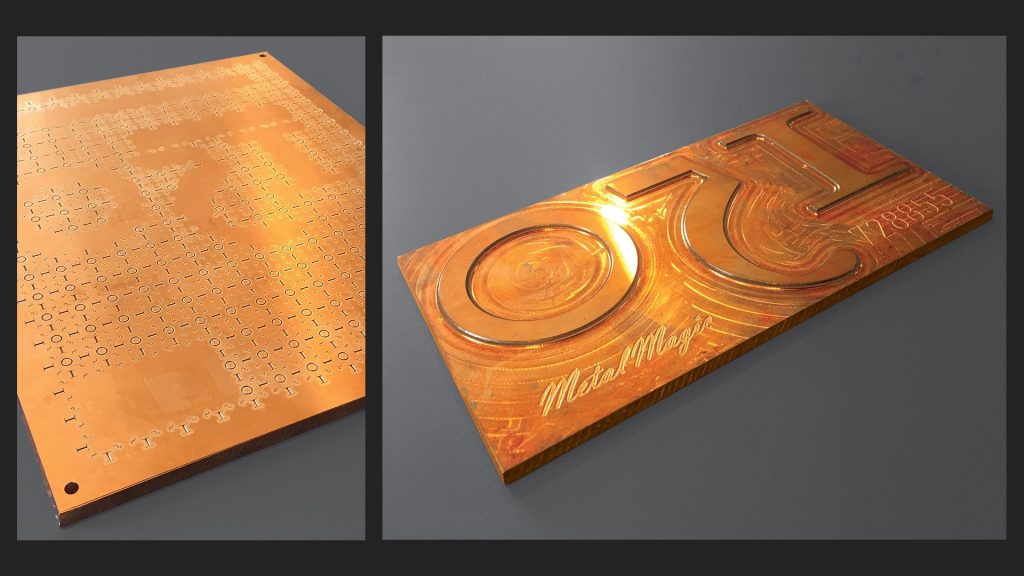
Note that the foiling block is wrong-reading, which results in a right-reading image. Hot Stamp Foiling does not use a female block. To create this look, the hot stamp foiling was done first and the blind embossing second. If this went in reverse order—the Hot Stamp Foiling would likely flatten the Blind Embossing.
Embossing & Foiling Blocks
These blocks all began as vector contour drawings from which the die-maker machines the image from either metal or a composite material using a router cutter. Due to the fine level of detail, these blocks have been machined from brass which is more expensive than composite material, but will last longer.
If used enough, embossing/debossing blocks will eventually wear out around the edges and the results will become much less defined. With this in mind, one thing to consider when embossing/debossing is potential future reprints. If reprints are probable, metal blocks may be more economical in the long run.
Note that embossing/debossing blocks can be single-level (resulting in a single step of embossed depth such as these examples), multi-level (resulting in varying steps of embossed detail), or continuous 3-D forms (a smooth shape of varying depth without any noticeable stepping).
