

Letterpress printing is a form of relief-printing. It dates back to the 1450s, when Germanborn Johann Gutenberg famously printed 180 copies of the Bible on his new invention. Letterpress was the dominant form of mass printing for 500 years, until superseded by Offset Lithography in the 1950s. Whilst no longer viable for producing long-run quantities, Letterpress has made somewhat of a comeback in recent years as a bespoke form of short-run printing. This is largely due to it’s unique tactile, debossed, crafted look and feel. You can’t beat the luxurious aesthetic of Letterpress on quality paper for invitations, business cards and stationery, certificates and art prints.

Old-school Letterpress employed individual letter-forms, or ‘moveable hot-type’, typeset within a Galley (a wooden frame). The loaded Galley would be secured onto the press, inked with a roller, and ‘pressed’ onto the paper (hence: letterpress). When the operator had finished the job, they would break the Galley and clean the letter-forms for reuse. For printing images, an operator would make metal engraving plates by hand and insert them into the galley—a time-consuming and expensive process. This concept of ‘moveable type’ was the main driver behind the spread of mass-produced books that led to universal literacy and deep social change.
In more recent times, photopolymer plates have replaced both the original type galleys and engraving plates. These polymer plates are made using a photoengraving process. They allow for much finer detail, and are significantly more efficient to produce. Most letterpress printing produced today uses polymer plates (although some artisan printers might still use hot-type).
Note that Letterpress predominantly uses Pantone Spot colours—instead of CMYK-based inks (although these can be used—it is not common to do so)
Letterpress Printing
Photopolymer plates are the modern alternative to hot type. These allow significantly more flexibility in design and are more efficient to produce.
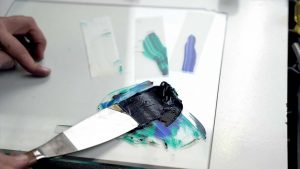
Letterpress printing is not specifically a CMYK based process but predominantly uses Pantone Spot colours. This requires the printery to hold the base inks for the Pantone system.
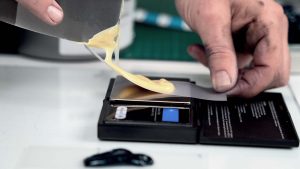
The operator mixes the Pantone colours by hand (left). They use a Spectrophotometer (right) to read the colour density ensuring the mix is accurate.
The operator then loads a photopolymer plate onto the Letterpress.
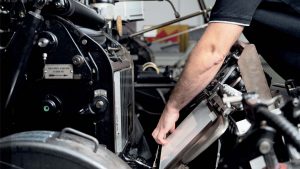
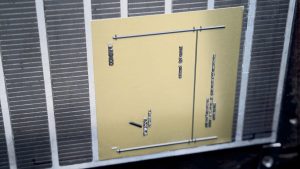 And adds the ink to the Letterpress by hand. The ink then runs through a series of rollers to even the spread (left). Once the Letterpress is running, the final ink roller passes over the printing plate (right).
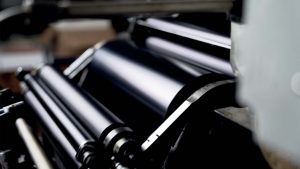
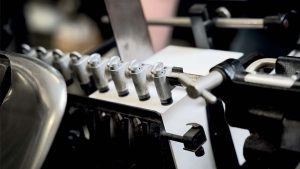
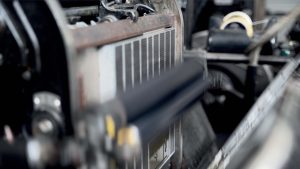 This leaves ink on the raised relief. A series of suction cups scoops up the paper stock. The paper is fed into the press and stamped onto the plate.
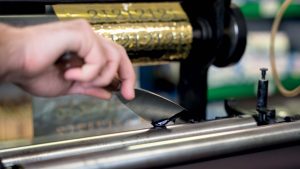
 Time is requires for the resulting printed sheets to dry. The operator then trims them down on a guillotine to the finished piece.
 This example is a business card (left). You can clearly see how the stamping has pressed into the paper stock giving a debossed effect.
Creating Artwork
As a print medium, Letterpress printing is best suited to lineart graphics and type created in a vector-based app such as Adobe Illustrator or InDesign. If you plan to use photographic images—speak to the printery first as there will be some important technical constraints around how to use them. Letterpress printing tends to use Pantone colours as opposed to CMYK (it can do both—but the process makes best use of Pantone colour). Often projects are set up in one to four Pantones and make use of overprinting. For more information on setting up artwork using Pantone colour—https://www.gsmmagazine.co/artwork-colour/
Hot Type & Linotype

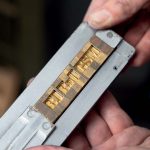
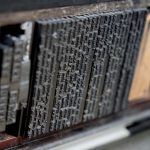
For Centuries, Letterpress printing employed individual letter-forms made from wood and/or metal. In the 19th Century, moulded lead letter-forms known as ‘hot type’ became standard . Hot type was traditionally made by ‘Type Foundries’. Hence the use of this term today to describe a company that creates typefaces. One disadvantage with hot type was wear and tear through constant reuse. Hot type was therefore phased out and replaced by ‘single-use’ moulded lines-of-type—‘linotype’.
Linotype employs compositing individual letterform moulds together to form sentences or lines —which are then cast to create a singular ‘slug’. These slugs are set in a Galley with strips of metal ‘leading’, inserted between to create line spacing. Thus forming a complete page ready for loading onto the letterpress. At the end of a print job, the operator disassembles the Galley and melts down the slugs for repouring.

The Legacy of Letterpress Printing
The 500 year legacy of Letterpress lives on in many industry terms we still use today—for example; the terms ‘upper case’ and ‘lower case’ originate from the storage of movable type. Both upper and lower case letters were stored in boxes called ‘cases’. Lower case letters, which were more frequently used, were stored on ‘lower’ shelves for easy access—upper case letters were stored on the ‘upper’ shelves. Another term from Letterpress still used today is ‘leading’. Originally, ‘leading’ referred to strips of metal which the operator placed between the lines of moveable type. This created the necessary spacing. These spacers were cast from lead—hence ‘leading’.
