

Sustainability and looking after the environment are important considerations when selecting a paper grade for your print project. The environmental credibility of paper is expressed through a series of Credentials covering various aspects of paper manufacturing, such as where the raw material originates from, how these materials have been grown and harvested, the manufacturing process itself, and the general impact of papermaking on the environment. Environmental Certifications can be split into different levels of accreditation as follows:
- Chain-of-Custody Certifications
- Mill-level Certifications
- Product-level Certifications
Chain-Of-Custody Certifications
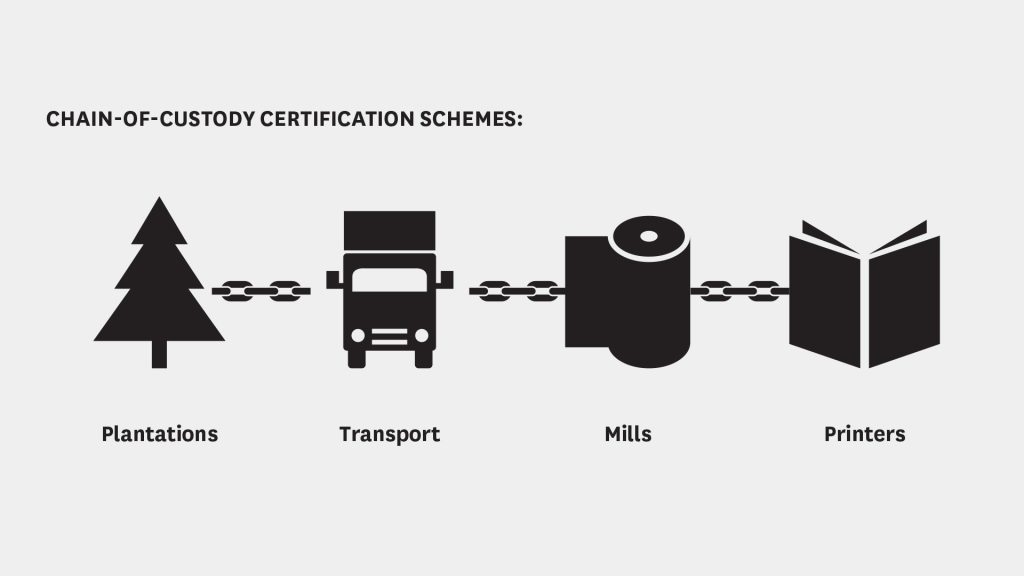 Chain of Custody Certifications are applied to paper from end-to-end―meaning; from origin to printing press. The purpose of this is to ensure all parties, along the pipeline through which the stock passes, are operating in an environmentally conscious manner, and in accordance with the rules of the Certification scheme. This begins with the wood pulp originating from a legal, well-managed and sustainable source, and continues through paper manufacturing all the way to the end printer―every step is tracked. Due to the strict operating and auditing processes―Chain-of-Custody Certifications are considered the highest level of environmental certification. The following Chain of Custody Certifications apply to many of the products within the BJ Ball / Ball & Doggett range:
- Issued by The Forest Stewardship Council®
- (FSC®):―FSC Mix: the product is made with a mixture of materials from FSC certified forests, recycled materials, and/or FSC controlled wood. While controlled wood does not come from FSC certified forests, it mitigates the risk of material originating from unacceptable sources.
- FSC Recycled: The product is made from 100% recycled materials― making the most of precious forest resources and reducing the pressure to harvest more trees.
- Issued by The Programme for the Endorsement of Forest Certification – PEFC.
Mill-Level Certifications
These Certifications relate specifically to the individual paper mills and their operating practices. Mill-level Certifications can be issued and audited by a third party organisation (such as ISO), or are self-issued by the mills themselves. In relation to BJ Ball / Ball & Doggett products, the applicable certifications are;
- ISO14001: Issued by The International Organisation for Standardisation (ISO)
- EMAS: Issued under The European Eco-Management and Audit Scheme (EMAS)
- EMS: An Environmental Management System (EMS) as developed and implemented by the mill (self-issued).
Product-Level Certifications
Product-level Certifications apply to individual paper stocks and are issued by various environmental organisations as a way to communicate specific features of a product—these include:
- Carbon Neutral (CN): Certified Carbon neutral papers have had any emissions generated during manufacturing offset by carbon credits.
- Elemental Chlorine Free (ECF): The pulp used in these papers has been whitened without the use of chlorine gas.
- Process Chlorine Free (PCF): Chlorine-Free paper is made from recycled fibres that were not re-whitened using chlorine bleach.
- Recycled Paper: The product has been made using waste paper (see side note about Recycled Paper).
Using Environmental Icons On Your Artwork
One way to fly the flag for a greener future is to show that the paper stock you choose is environmentally sound—this can also be a benefit to your clients as a demonstration of commitment to their own environmental policies. You can show this on your artwork by using the applicable environmental icons. You can download many of these from our respective websites—go to:
- New Zealand: //bjball.co.nz
- Australia: //ballanddoggett.com.au
Using the FSC & PEFC Logos on Artwork
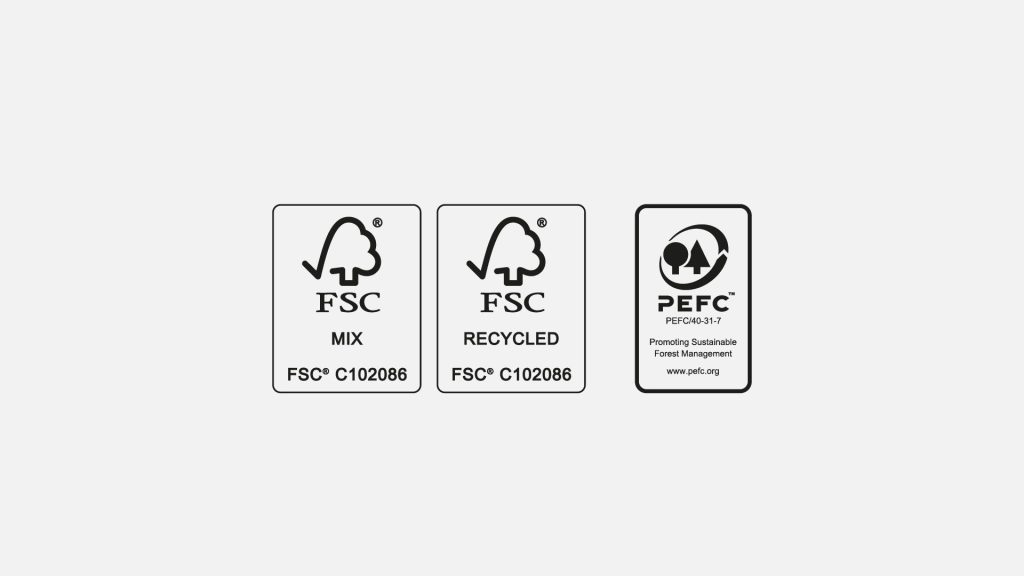 The above trademarked logos for the FSC and PEFC Chain-of-Custody Certification schemes can be shown on artwork as a way to substantiate the environmental credibility of your project—providing all parties within the production chain, including your printer, are certified within the scheme.
The designer is not required to be certified. As your printer needs to be a member of the scheme, they will need to request the applicable logo file from the certification body, on your behalf.
Environmental Credential Icons
 The above icons identify the different environmental credentials in relation to the stocks within the BJ Ball / Ball & Doggett product ranges:
- FSC Mix / FSC Recycled
- PEFC
- ISO14001
- EMAS
- Mill System (EMS)
- Carbon Neutral
- Elemental Chlorine Free
- Process Chlorine Free
- Recycled Paper
A Word on Recycled Paper
Paper is one of the most recycled products in the world— which is great news for the environment. Recycled paper makes the most of precious forest resources, reduces the pressure to harvest more trees and reduces landfill. The type of waste used to make recycled paper tends to originate from the following sources:
- Mill-broke waste: This specifically relates to trimmings, off-cuts and other scrap discarded during paper manufacturing.
- Pre-consumer waste: Is waste from the printing process, commonly consisting of trimming off-cuts and run-up sheets. This material is recycled by the printer.
- Post-consumer waste: Anything discarded after consumer use, such as cartons, magazines, newspapers (think of your recycling bins).
One of the challenges with making recycled paper using waste is that the fibre strength diminishes when the paper is turned back into pulp. For this reason, many recycled papers suitable for high-quality printing are made by adding virgin fibre into the mix. This ensures the paper is strong enough and provides a quality surface for printing. Paper can be re-pulped many times, until eventually the wood fibres break down to the point it is no longer usable. At this point, the waste goes to landfill where—because paper is made from wood (a natural material)—it biodegrades and breaks down.
