
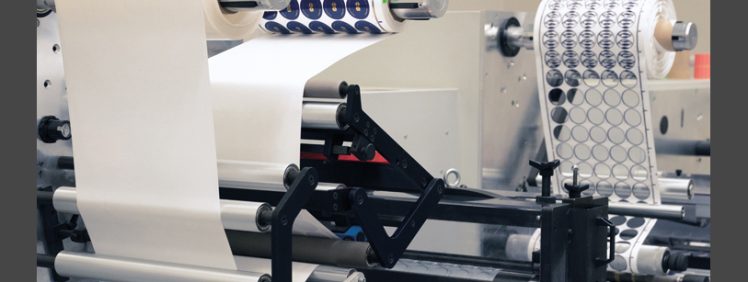
In this Education article, GSM takes a close look at label printing. And, cover how to get the most from your project…
There are four main areas of consideration when it comes to label printing. The label stock, the adhesive, the print method, and the print specials & embellishments. Let’s look at each in turn:
Label Stocks
At a commercial level, most labelling stocks are supplied to label companies as bulk rolls.
There are three main processes for label printing. Flexography, offset lithography (referred to in the print industry as ‘conventional’ methods) and digital printing (see print methods).
At the end of the print process, the labels are rerolled and dispatched to the client.
The finished labels are applied to the product as a separate process at the client/manufacturing end using a labelling application machine.
Most labels are ‘peel & stick’ self-adhesives, comprising two main parts: a facestock and a backing liner. The facestock is the ‘label’ part, made from paper or synthetic material—but there are other options (see below). The backing liner is the ‘roll’ part from which the facestock/label is peeled during application, and then discarded. It is usually made from either kraft paper or synthetic (PET) with a silicone coating (to help the peeling process).
Choosing a labelling stock with the right facestock is critical for several practical reasons beyond aesthetics alone. Here are some things to consider;
- Durability: Some products get knocked around, have a long shelf life, are exposed to chemicals or the outdoors. In this situation, synthetic facestocks are generally more durable than paper.
- Pliability: Labels are often applied to flat or regular cylindrical surfaces—which is usually no problem. However, irregular or complex rounded surfaces require a facestock that is pliable enough to follow and adhere to the form.
- Moisture resistance: Products destined for storage in chillers or freezers—such as beverages or chilled/frozen foods—require a facestock that is moisture resistant. This avoids the label pulling apart or peeling off.
- Recyclability: Where a product is recyclable—the affixed label also needs to be recyclable for the product to be processed in this manner. Using a non-recyclable label on a recyclable product unfortunately means the product will go to landfill.
Facestocks come in a wide array of looks, colours, textures and finishes. All of which contribute to the overall aesthetic. A specialist label print house usually holds a range of ‘house’ stocks with options for uncoated, coated, white, off-white, kraft and black. However, many non-standard options also exist. These can include facestocks made from bamboo, cactus fibre, wood veneer, recycled paper, cotton and fabric. All of which create distinct looks. For a full range of stock options—contact your BJ Ball/ Ball & Doggett representative or see our website.
Some facestocks are more sustainable than others. Specifically, paper-based labels are generally a greener choice than synthetics. All Ball & Doggett /BJ Ball stocks have environmental profiles available that outline the green credentials of the stock to help you make an informed choice—contact your BJ Ball/Ball & Doggett representative, or see our website for more information
Label Adhesive
The second consideration is the adhesive—the glue on the back of the facestock.
Choosing the right adhesive is critical for many reasons;
- Permanency: Adhesives range in strength from removable and semi-permanent to permanent. Labels with removable or semi-permanent adhesive can be removed—which might be an important consideration, particularly where the label is attached directly to the product, such as labels applied to clothing, electronics or food goods. Labels with a permanent adhesive are not designed to be removed and may damage the product or leave a residue if peeled away.
- Moisture resistance: If the product to which the label is applied is exposed to moisture (think: products used outdoors or products stored in chillers/freezers), the adhesive must be moisture resistant, or the glue may fail.
- Freezer grade: If the label is applied to a pre-frozen product—the label will need to be freezer grade to ensure it sticks on contact.
- Temperature Sensitive: Some products are processed in very hot or cold environments. The adhesive must be suitable, as extreme temperatures and variations may affect some glues.
- Chemical Resistance: If the label is being applied to a bottle or container holding an oil or chemical (think: beauty products, cleaning products, motor oil)—the adhesive needs to be suitable, or the glue will likely fail if contacted by the chemical.
- Food grade safe: Where the label directly contacts food—the adhesive must be food safe to ensure no health concerns and that the glue will not taint the flavour.
- Recyclability: Like the facestock, the adhesive also plays a key part in determining if the product to which the label is applied, can be recycled. As such, there are adhesives made specifically to assist with the recycling process.
Choosing the correct adhesive should be part of the project pre-planning. This requires consultation with the client, your printer and/or your BJ Ball/Ball & Doggett representative. We also recommend ordering a stock sample and undertaking test applications to the product before going to print.
Methods of Label Printing
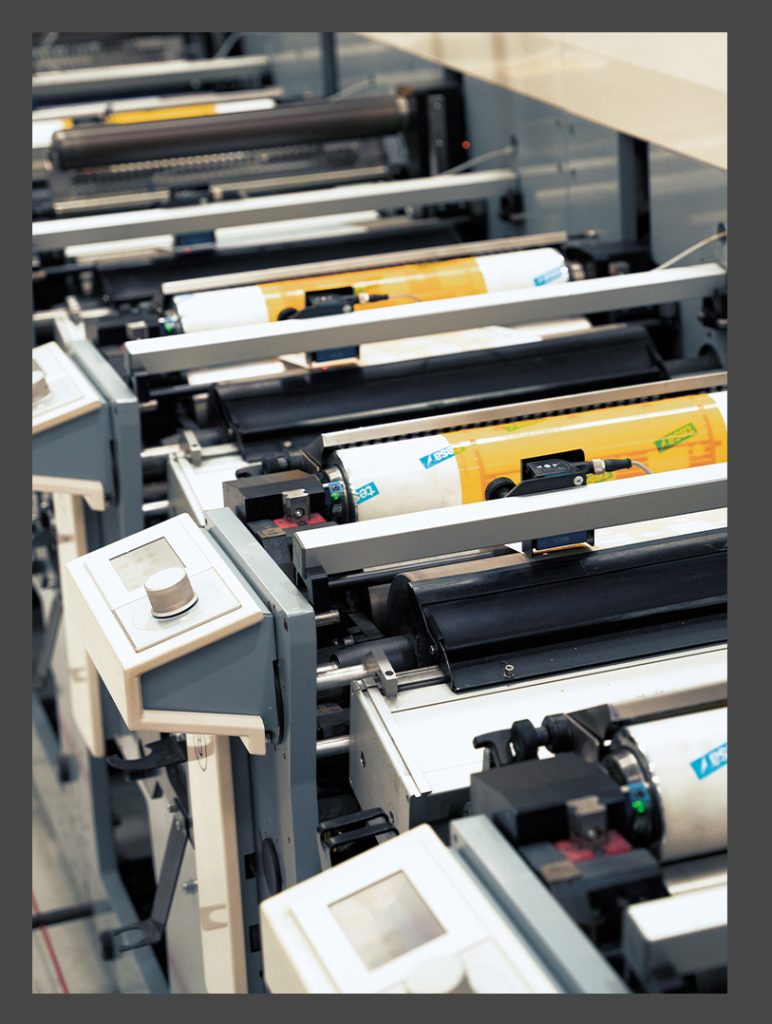 Most labels are printed using either flexography, offset lithography or digital printing.
Labelling presses for these processes can run paper or synthetic substrates and offer very high print quality.
- Flexography and offset lithography, require prepress and platemaking. This adds up-front costs to the project, but the actual printing speed is very fast. Due to these factors, these processes are best suited to large quantities. The labels on most products on supermarket shelves are produced using one of these processes.
- Digital printing offers greater flexibility, lower set-up costs, and can result in faster turnaround times compared to the other two processes. It is best suited for producing smaller quantities. Some digital printing systems can use variable data. This means every label can be personalised or unique in some way. Perfect for small batch editions, event marketing, individual targeting, and for adding different Stock-Keeping Units (SKU’s)/barcodes to each label. Artisan foods and limited-run alcohol products often feature digitally printed labels.
Ultimately, which process best suits a project comes down to a combination of quantity, desired colours & specials, size of the label, and budget.
Colour Specials
Flexography, offset lithography and Digital label printing are all CMYK ‘Process’ colour-based processes. They use Cyan, Magenta, Yellow and Key-Black (CMYK) to create a printable colour spectrum. In addition, ‘specials’—non-CMYK-based colours—can expand this spectrum and create different looks. It is important to note that the colour specials used in flexography and offset lithography are different from those used in digital printing.
In flexography and offset lithography, the most common print ‘specials’ are ‘Spot’ colours, drawn from the Pantone Matching System (PMS). This range of more than 2400 colours facilitates metallics (bronzes, coppers, silvers, golds plus a range of metallic-based colours), neons, pastels, and many colours that do not reproduce well in CMYK (such as bright oranges and violets). Pantone colour can be employed in addition to, or instead of, CMYK.
Many digital print systems also offer ‘special’ colours—but note that these vary from system to system. In general, digital print systems can simulate many of the colours from the Pantone Matching System. However they do not actually print using Pantone inks. If you are using digital printing and wish to employ colour specials—ask your printer as to what specials their system can run.
Correctly setting up artwork files is crucial when using print specials. If you have limited experience setting up artwork, we recommend talking to your printer as they can often provide guidance in this area.
Pantone Colours
 Pantone ‘PMS’ Spot colours used in flexographiy and offset lithography are pre-mixed to the desired colour “off the press” according to the Pantone ink formula. The colours themselves are selected using a Pantone Swatchbook.
This flexographic print unit displays the ink tray and anilox roller. The use of Pantone ink is very common in flexographic-based label printing (and other forms of packaging).
Non-print Specials & Embellishments for Labelling
In addition to colour specials, there are also non-print specials you can use in your project, such as:
Print coatings and varnishes –
The most common print coatings and varnishes are;
- Varnishes: Used primarily to protect a printed piece from moisture, scuffing, and general wear and tear. These sealers also subtly contribute to the look. They are available in matt, satin and gloss finishes. They can be applied as full-coverage across the entire page (all over) or in specific ‘spot’ areas (e.g. logo or design feature). An alternative to a full-coverage vanish, that also protects the printed surface and strengthens the label, is laminate film.
- High-build varnish: High-Build is a type of spot varnish that creates a raised transparent surface. It can be used as an alternative to embossing (see overpage), or to create textures on the label to highlight key design areas, or add textured patterns.
- Spot Coatings: Spot coatings are a transparent protective coating. They are used in a similar manner to varnish but with a more prominent look.
Embossing
Embossing creates an area of raised relief. This process requires male and female tooling, which stamp the label stock as it moves through the press, creating a raised three-dimensional impression.
Debossing uses the same method but with the tooling swapped over, creating a recessed relief.
Common areas for embossing are logos, pictures, graphic elements, product names or borders. We recommend discussing embossing with your label printer early in the design process, as tolerances and variables may influence what can or cannot be embossed.
Foiling
Foiling is a non-ink-based process of adhering a micro-thin metal ‘foil’ onto the label. This creates a unique aesthetic, different from metallic Pantone ink or digital metallic toner. It has a more ‘true’ metal look.
Foil can be applied using either a hot-foil or cold-foil method. These are two different processes;
In hot-foiling, the foil is stamped onto the paper with a metal heated plate. Whereas in cold-foiling, the foil adheres to an adhesive laid down on the substrate. Hot foil is ideal for fine high quality detail and is suitable for use on uncoated and textured materials.
Common foil colours include gold, silver, bronze, black, white, holographic and some flat ‘pigment’ colours.
In label printing using flexography or offset lithography—cold-foiling is often done inline (meaning: in the same pass).
In digital printing, cold-foiling is often done offline (a separate process).
Hot-foiling is a separate process regardless of print method. Similar to embossing where tolerances may need to be considered. If you are planning to use foiling, discuss this with your printer early in the project.
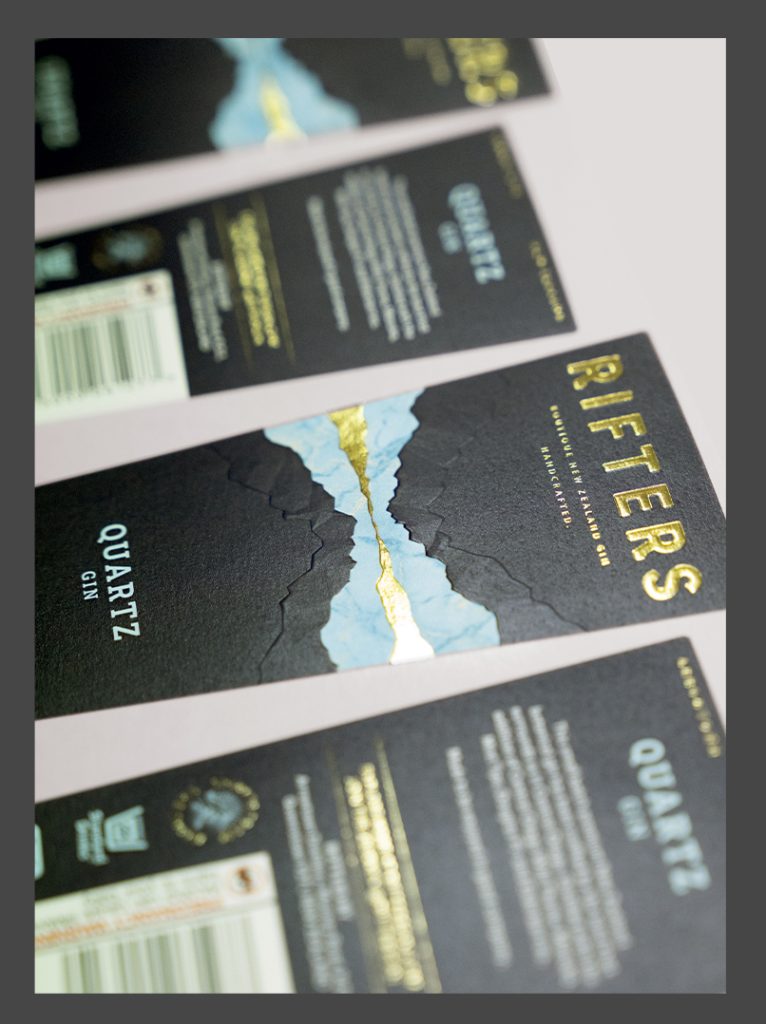
The below label set (fronts and backs) for this Gin product makes extensive use of both embossing and gold foiling including combination foiling (foiling over embossing) in the brand name. The underlying colour is straight CMYK.
Die-cutting
Die-cutting creates a form or shape out of the substrate.
In labelling, die-cutting is done as a KISS-cut. This is where a blade on a rotating cylinder only touches the facestock with enough pressure to cut this without cutting the backing liner. It is worth noting that all labels are KISS-cut to the intended shape. These are usually simple geometric shapes such as squares, rectangles or circles. However, more complex bespoke shapes can also be produced such as geometric angles, two-part labels, torn-edge looks, and custom shapes (note that this will increase the overall production cost).
Technical Considerations for Label Printing for a Designer
Label printing can be quite technical. And potentially less forgiving than other print methods—which can impact on design. Here are some considerations:
- Placement of embellishments: Most embellishments need space to ‘hit’ or to adhere. Do not place these embellishments on or near trim edges.
- Tolerances: Flexographic printing is slightly less forgiving than digital printing (or offset lithography). This is simply the nature of the process. Avoid areas of tight registration or very fine hairlines or lineart, as these may cause registration issues.
- Foiling or High-Build on fine hairlines: Foiling or high-build varnishes on fine hairlines can cause the finish to break up during the transfer process. Basically, avoid fine rules—period.
- Solids areas of high-build varnish: It can be challenging to achieve consistency across a large area using high-build. High-build works best applied to small areas.
- High-build varnish over whites & lights: Applying high-build over a white or light area is unlikely to be particularly effective. Applying the same effect over a dark or black area will be significantly more visible.
Digital Production Process
This label project, produced using digital printing, shows the different stages of the print and finishing process:
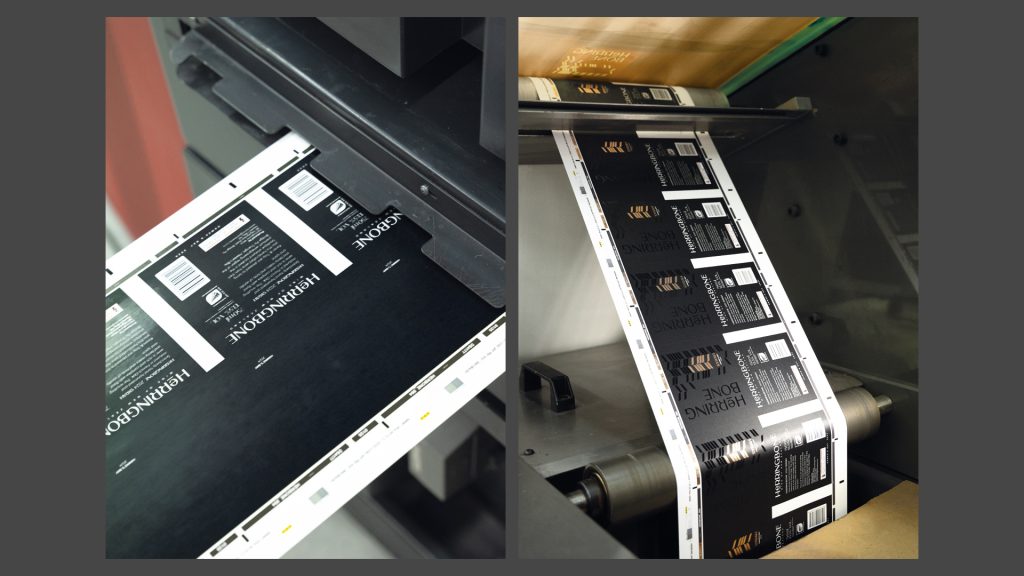 The first step is to print the artwork colour onto the required label stock. This label has been printed using Cyan, Magenta, Yellow, and Key-Black (CMYK).
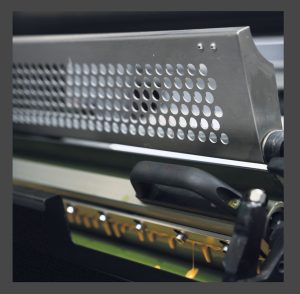
- The second step is to add the embellishments. This label uses a Matt Spot varnish, gold foil plus embossing. These are added using a digital finishing press. This photo shows the Spot varnish applied using an automated screen printing process. The squeegee draws the varnish through the stencil screen onto the substrate as it passes beneath.
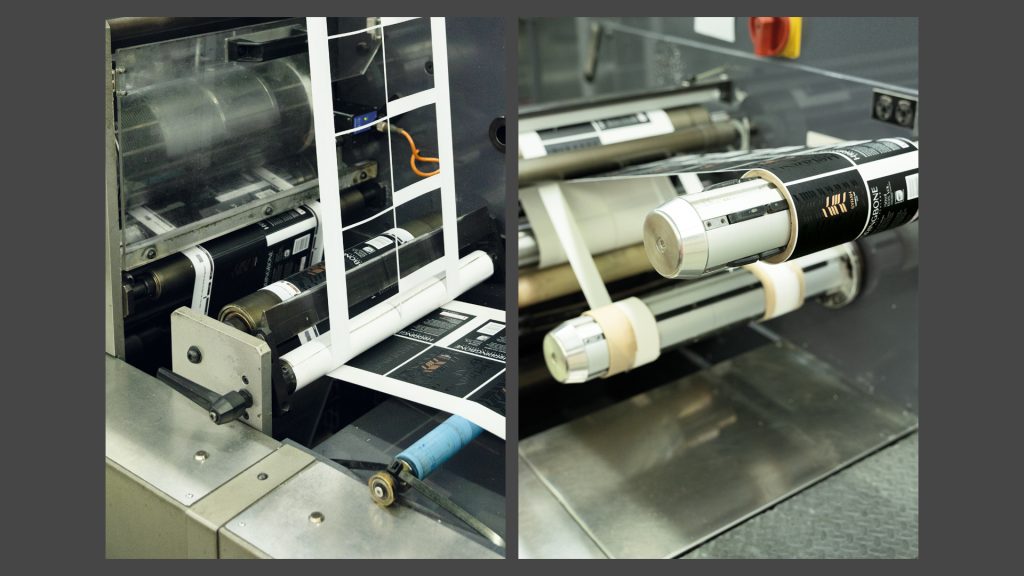 The third step is die-cutting. This is done directly after the embellishments have been added. The flexible die, kiss-cuts the label shape into the facestock. As the labels exit the press, the excess facestock is peeled away (the white material moving vertically), leaving only the trimmed labels on the backing liner (moving horizontally).
- The final step is to remove the excess backing liner, which is trimmed away (the bottom roll), and to re-roll the finished labels onto separate cores (the top roll).
Flexographic Labelling Press
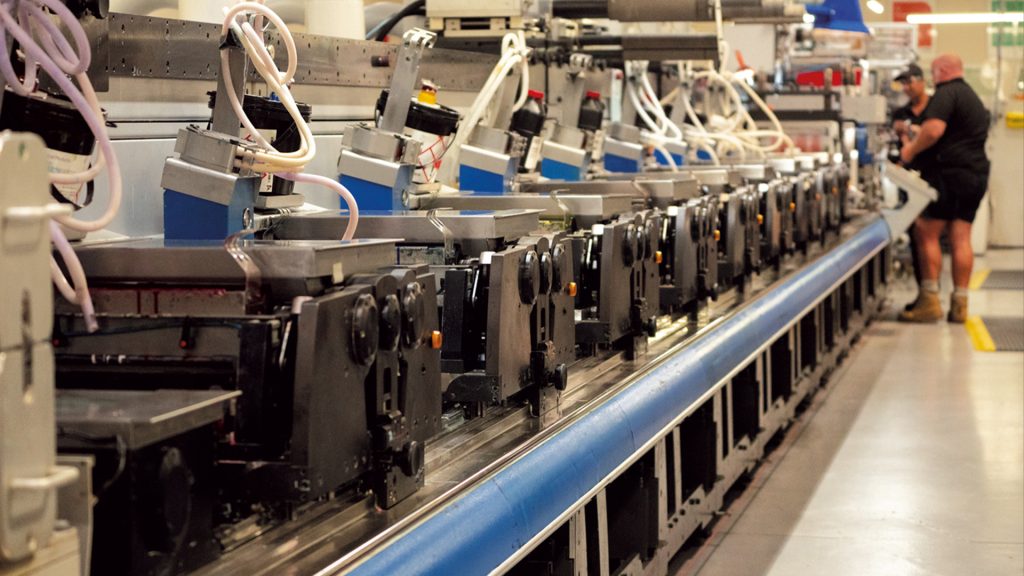 This 9-colour flexographic press can run up to nine colours in one pass on a range of substrates such as paper and synthetics. Commonly, this would be Cyan, Magenta, Yellow and Key-Black (CMYK). Plus up to five Specials (such as Pantone PMS colours and/or varnishes). A flexo press, such as this, prints at a very high speed. And is used for long-run print volumes often in the tens or hundreds of thousands of labels. Most labels on products on your supermarket shelf are printed using this method.
Specialty Labels:
Aside from standard labels—there are also several types of specialty labels available, the most common are:
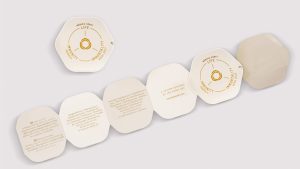 Extended Content Labels (top left): An Extended Content Label (ECL) is a label that has additional pages concealed within the label. There are many styles of ECLs including booklet and multi-layer peel and reseal labels. The advantage is that the compact label takes up only a fraction of its unfolded or unopened media space. The example opposite shows a multi-lingual ECL for a Mānuka honey product. At the top is a finished, folded label. Below this is the open extended label (which is printed both sides). Extended Content Labels are generally applied to products where the packaging does not provide enough surface area for all the required information.
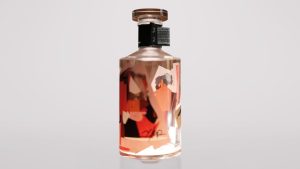 Double-sided Labels (left): A double-sided label has a printed image on both sides. As per this example, these labels are most commonly applied to plastic or glass bottles where you can see through to the opposite side. Double-sided labels are printed on the same side (the outside) with a white carrier printed between the two images. Tricky!
- Shrink Sleeve Labels (not shown): Applied to container or bottled products (think beverages, shampoos and bottled drinks)—shrink sleeves are typically plastic or polyester film. The printed shrink sleeve is applied over the container, then moulded using heat to the shape of the container. Designing for shrink-sleeving requires planning for the conformability of the label as it shrinks to ensure elements land in the correct place. Design prototypes can be tested using 3D software.
Summary
Hopefully, this article has provided some insight into the idiosyncrasies of label printing. We recommend discussing your ideas with your printer during the concept stage so they can provide technical guidance to ensure the best possible outcome.
GSM would like to thank MCC and their team for allowing us access to their print house and to ask them a million questions to which we received impressively knowledgeable answers! For more information on label printing with MCC—go to: //mcclabel.com
Photos by Xavier Murphy @xalaphotography
For more information on self-adhesive label stocks—go to:
- Australian readers: //ballanddoggett.com.au
- New Zealand readers: //bjball.co.nz
