‘Soft’ eco-packaging materials are appearing on our supermarket shelves as brands look to do the ‘right thing’ by replacing single-use plastics. There are many types of degradable, biodegradable, compostable soft materials available – but what do these terms really mean?
In GSM Re-Edit (pub. 2020) we looked at the concept of a Circular Economy and how we can significantly reduce landfill through smarter choices in materials, better recycling and reintroducing waste back into the manufacturing process. Part of creating a Circular Economy requires replacing synthetic materials with natural-based products that we can either recycle or biodegrade. This is particularly important in the packaging sector—one of the larger consumers of ‘soft’ single-use plastics. Leading this change is degradable or eco-packaging materials that, at the end of their usable life, breakdown instead of sitting in landfill. However, as GSM discovered, the realities of these eco-packaging materials are more complex than meets the eye. Being ‘green’ requires more than just words…
Terminology
You’ve probably already heard a number of buzz words when it comes to eco-packaging so, let’s start by understanding what some of these mean. Here are the most common:
Degradable:
Materials designated as ‘degradable’ may break down over time through exposure to environmental forces, ultraviolet light or through the use of pro-degradant additives. However, this is dependent on which material under what conditions. This process can still take hundreds or even thousands of years. At the end of the day, most of these materials will still go into landfill.
Oxo-degradable:
These fossil fuel based materials contain an additive that, when exposed to oxygen and sunlight, makes them break down into smaller pieces. These break down into micro-plastics which can potentially enter the food chain and harm aquatic life. Again, most of these materials are best going into landfill. Thankfully, the NZ government has instigated legislation to phase problematic plastics out by late 2022.
Biodegradable:
In principle, given the right conditions, naturally occurring micro-organisms like bacteria, fungi and algae pretty much ‘eat’ these products. All they leave behind is water, carbon dioxide and biomass. Biodegradation does, however, rely heavily on the right environment. For example, compost, soil, water and marine environments all contain very different micro-organisms. How active these micro-organisms are depends on the amount of oxygen and the temperature of their specific environment. Hence, a claim of biodegradability needs to specify both the required environment plus the length of time for this process to successfully occur. There is also a danger that once the product has biodegraded it can leave toxins behind. Unfortunately, most of these materials will still go into landfill.
Home Compostable:
These materials will, over a specified period of time within a home compost system, break down into water, carbon dioxide and biomass— without leaving traces of toxins. So, with a little user effort, these materials avoid contributing to landfill.
Commercially Compostable:
These materials require significantly more heat than what occurs in the standard home compost system. So these materials need to be processed at a commercial composting plant. Currently, there are only a handful of these purpose-built facilities operating in New Zealand.
The Importance of Certification
It is important to note that when it comes to any claim of being eco-friendly, the endorsement of a recognised certification standard is the only way a consumer can have faith that the material meets the claim. For compostable soft packaging products sold in New Zealand, the most recognised certifications are:
Australian Standard AS 4736-2006: Industrial Compostability:
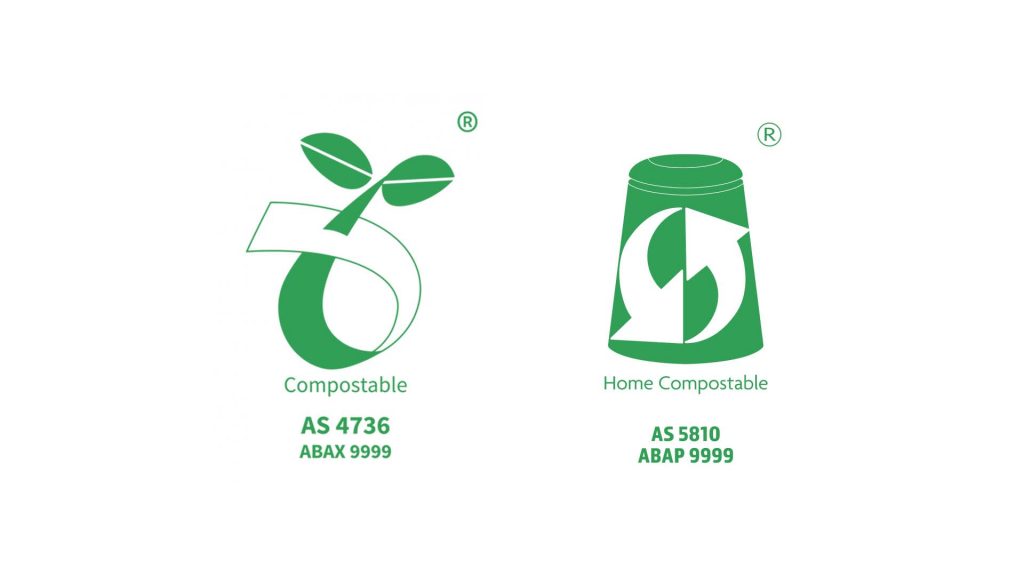
In Australia, to certify a product as industrial compostable, a recognised, accredited third party assessor must stringently test it. This testing requires that 90% (or greater) of the product should disintegrate into 2mmpieces (or smaller) within the first 12 weeks in compost. By the end of the testing period (180 days in compost) a minimum of 90% of the product should have achieved biodegradation. The standard also measures toxicity. The product must show no toxic effect on the compost, plants and/or earthworms. In addition, hazardous substances such as heavy metals must not appear above the maximum allowed levels. Certification also requires the products to contain at least 50% organic material. Products that are certified AS 4736-2006 use the ABA Seedling Composting Logo (see figure 1) for identification..
Australian Standard AS 5810-2010: Home Compostability
Although home composting is on a vastly different scale to industrial processes, the core requirements for certification are mostly the same. The main difference is the testing period increases to 12 months. This is to compensate for the slower rate of degrading resulting from lower temperatures within home compost systems. Products that are certified AS 5810-2010 use the Home Compostable Logo (figure 2) for identification.
Can Home Compostable Materials go into Industrial Composting and vice-versa?
This is a common question with Compostable Packaging materials. The answer is yes—and no! AS 5810-2010 Home Compostable Certified materials are suitable for Industrial Composting. However, this does not apply the other way around. Industrial Compostable products are unlikely to degrade in home compost as there is simply not enough heat generated to initiate the process. The takeaway here is—don’t throw Industrial Compostable materials into your home compost.
For more information on Commercial Composting Facilities operating in NZ—go to: //www.wasteminz.org.nz/sector-groups/compost-nz/new-zealand
BJ Ball Home Compostable Film (HCF)
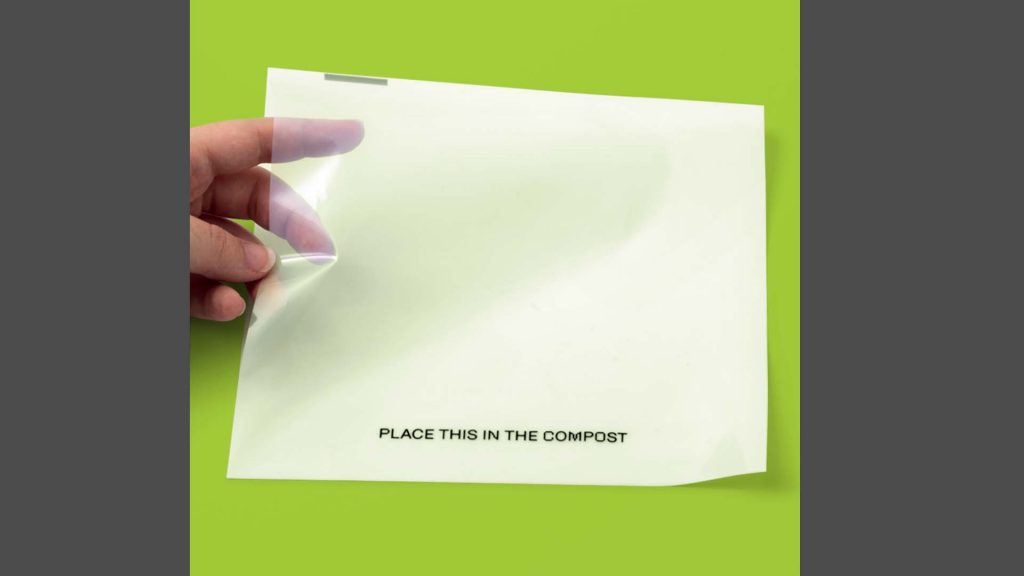
In 2020, BJ Ball introduced Home Compostable Film (HCF) to their packaging range. This highly transparent film is an excellent alternative to conventional flexible plastic films, like polythene, and is designed to biodegrade just like organic waste in home compost.
HCF is certified Home Compostable under the European standard OK Home Compost and the Australian standard AS 5810-2010. In ambient conditions, HCF decomposes into biomass, carbon dioxide and water.
Moisture and grease resistant and stable at high temperatures (up to 100°C) HCF complies to US FDA and European food safety standards. This makes the film suitable for a wide range of food applications including fresh produce, dry food, baked goods and chilled/frozen food. It is also suitable as a bag material for retail products such as apparel. Another advantage of HCF is its’ low heat seal temperature and excellent heat seal strength at a thinner thickness compared to many other available bio-plastic options.
HCF prints extremely well without any pre-treatment —or—can be applied as a protective barrier liner to a variety of other materials. A great alternative for non-biodegradable plastics.