

We recently caught up with Janice Page, General Manager at Caxton, to hear her thoughts on working with the current crop of Kiwi design students.
Caxton (formerly The Caxton Press) was founded in Christchurch in 1935 by celebrated New Zealand poet and publisher Denis Glover. The award-winning printery has a long history of producing high quality work and supporting the local industry. Recently, Caxton printed the NZ edition of the BJ Ball Calendar featuring winning entries from our 2024 Student Design Contest. Here’s how it all went down…
GSM: Does Caxton have much involvement with Tertiary design schools and their Visual Communication students? E.g. presentations at the schools about print, student visits to the printery, student internships?
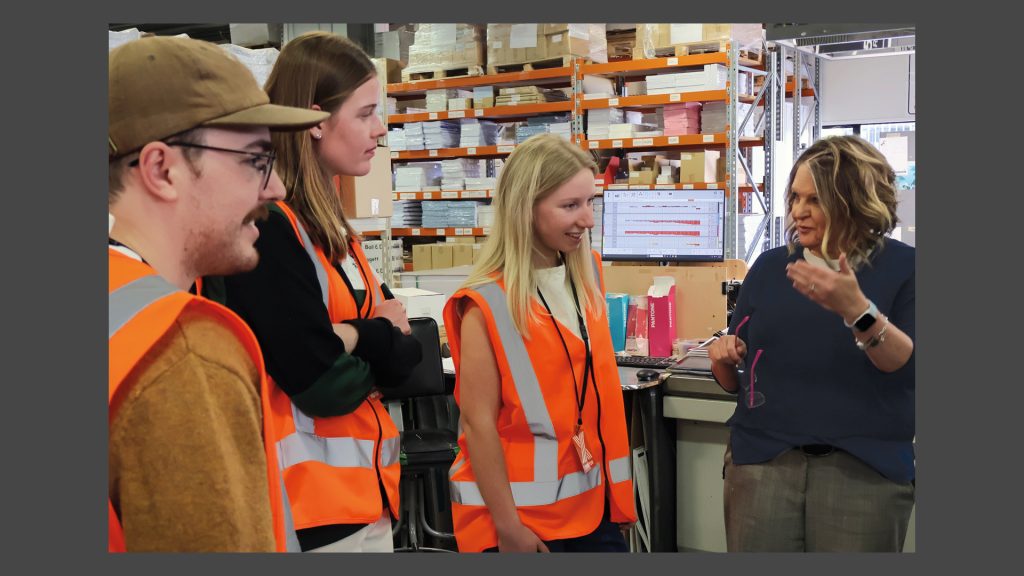
Janice: We have had many students tour Caxton over the years. Often these are high school level, usually Year 12 and 13, art and design students wanting to learn more about commercial printing. We take them on a tour of the site and show them the entire process. From our inhouse design team and what they do, through to prepress, printing and onto the bindery.
GSM: You recently hosted a group of Tertiary students for the press pass of the 2024 BJ Ball Calendar—why is this beneficial for Caxton?
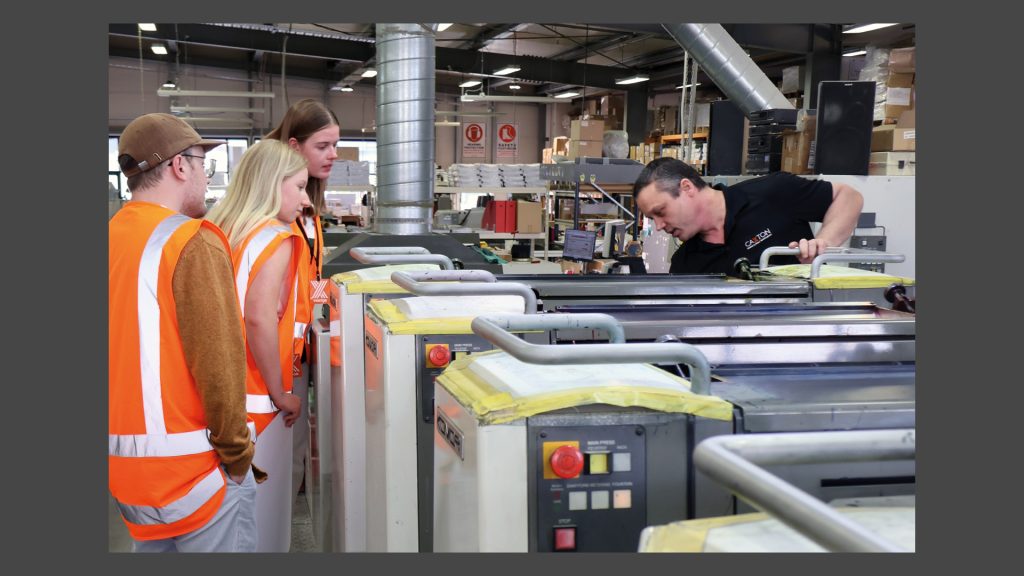
Janice: It was great having students of design visit our factory and see the press in action. Our print operator, Neil Martin found it rewarding passing on his vast knowledge. We like to talk about our craft and these students were truly keen to listen and learn.
GSM: How did the students react to seeing a large-scale printery in action?
Janice: Judging by the number of questions, they seemed very engaged. They particularly enjoyed seeing the many steps to bring the colour up to the required density to match the proofs.
 GSM: How did they react to seeing their own artwork being printed?
Janice: For a student, seeing your work being printed on a commercial scale for the first time is an exhilarating experience and I think they got quite a buzz. The vibrance and detail in the printed output comes to life in a way that a digital screen just can’t capture.
GSM: The calendar includes a wide mix of different paper grades— does this affect the way you approach the job?
Janice: Changes in grammage (weight) is not particularly challenging—things become trickier when shifting between coated and uncoated stocks within the same print job as we did on the calendar. The mix of stocks, as well as different colours and shades of stock, each present a different challenge. We use output profiles based on the different stocks at the plate making stage to ensure the best result. For uncoated stocks, we look to reduce the amount of ink held on the plate so less is transferred onto the paper. This results in clean midtones. The danger with uncoated stocks is that images can go dark or muddy due to the increased absorbency. On coated stocks, thanks to the coating, the ink sits more on the surface, meaning there is less absorbency. This makes it easier to achieve bright, vibrant images.
In addition, for this project, we printed on one coloured stock (BJ Ball Trophee used for the June page). Coloured stocks present the added complication that you don’t know how the final result will look until it’s printing as the underlying stock colour will cast the ink laid down on top. It’s a bit of a guessing game how it will look.
Shelley, who works at the estimating stage, pointed out there was one paper where the stock colour affected the corresponding artwork,J56 and so we swapped a couple of images around so the orange stock complimented the orange of the design.
GSM: Are there any tips about offset print that you can offer our emerging batch of graphic designers heading into the industry?
Janice: Visiting a press to experience the different processes that go into getting a project onto the press and to see a printing press in action. This is a great learning opportunity. Learning best practices around your artwork, so that when you are designing something really beautiful you are ensuring that all your creative ideas will work well in print. Being a designer myself, working in a printing environment has greatly improved my skills.
DAY AT THE PRESS
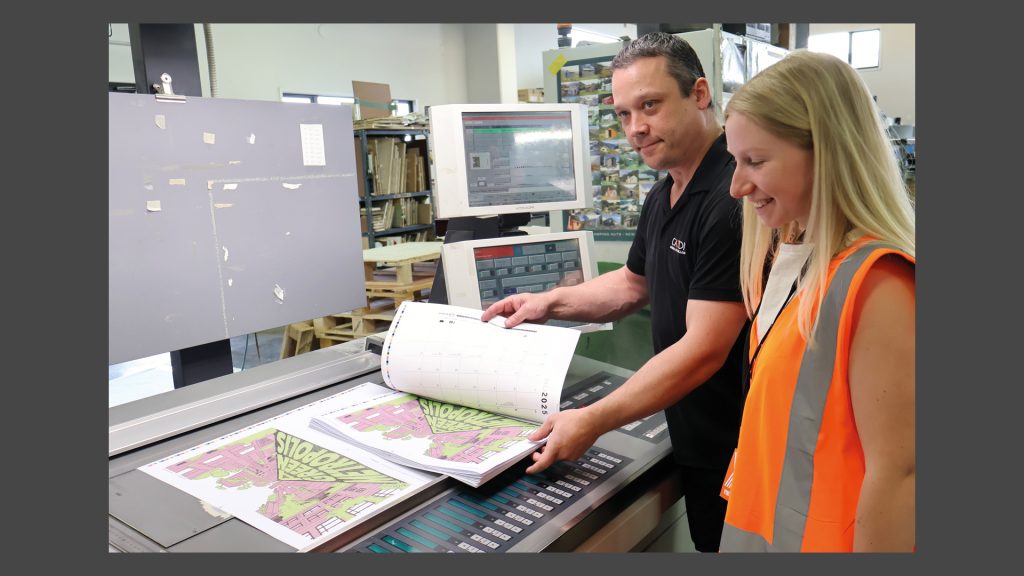 In late 2024, local design Students visited Caxton to see pages from the 2025 Calendar running on the press. Direct industry experiences like this provide a valuable learning opportunity. In this way students can apply learnt classroom theory to the real world. Generally, most design students have limited exposure to commercial level printing before visiting a plant. They are often surprised at the size and complexity of the operation
 BJ Ball would like to thank the team at Caxton for their input into the 2024 Student Design contest. For more information on Caxton—go to: //caxton.co.nz
